Let’s talk about materials for a moment.
For starters, wind load on a shade structure is significant; shade sails are attractive for their utility, aesthetics, versatility, and reasonable cost as compared to a rigid-roof structure. However, the word “sail” is right there in the name: Turn it vertical and attach it to a boat and it will drag a hundred tons across the world.
Scope of this article
For the purposes of this article we’ll focus on anchoring to columns (vertical elements that may or may not be canted) with either an in-ground footer or an attachment to some element at ground level. In a separate article we will discuss what we do when attaching to an edifice.
The “cheat” answer
I’ll go ahead and give you the “cheat” answer: Steel. Read on to find out a bit more.
Wood columns
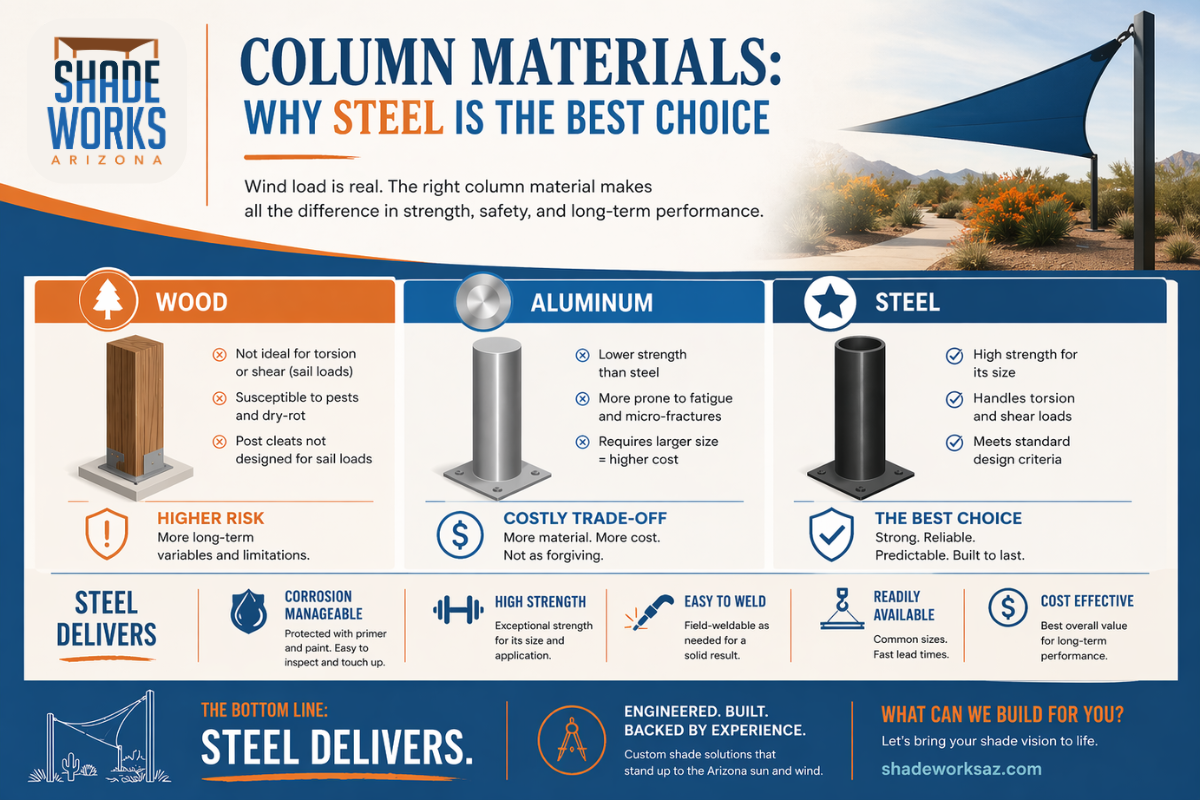
We get requests quite regularly to attach to ground-supported wood columns. This is a situation where we would decline the work. Lumber can be quite strong, so why wouldn’t we use it for this application? It is, after all, cheap and readily-available.
For one, wood is not good at plastic deformation. When pushed it tends to spring a bit and then splinter, and that splintering is irreversible and at each subsequent event the breakage will worsen. Contributing to this is that lumber, even pressure-treated lumber, is susceptible to pests. While PT lumber is often treated with chemicals such as borate, this makes it termite-resistant but not termite-proof. Additionally, even good lumber is susceptible to dry-rot. While these problems are not likely to manifest very quickly – generally they take 5+ years to show problems – they’re considerations, and they make attaching to wood columns a somewhat controversial position.
Additionally, most wood columns that we’ve seen have been designed to fit with post cleats; these cleats are excellent for holding lumber in position when it is in compression (e.g. a patio roof), but are not very good in torsion or in shear (e.g. with a sail). While this could be considered to be part of footer design, at some point even the Simpson catalog does not have an item to address the torsional loading of an 8-foot-tall column with 800lb. of force being applied at the distal end.
Aluminum columns
While it is unusual, every so often we are asked to use aluminum material for columns. Though it is true that aluminum will not corrode in the same way that steel can and it will not splinter the way wood can, aluminum has its own sets of caveats.
Specifically, we don’t tend to use aluminum because of its lower yield strength as compared to steel. For a given cross-section, an aluminum element has a lower modulus of elasticity; this means that, in short, when it is deformed, it tends to stay deformed rather than spring back. As compared to steel of the same size, it takes less stress for aluminum to reach its plastic deformation limits and bend.
Moreover, aluminum fatigues much more easily than steel and will start to develop micro-fractures along stress lines; these will eventually cause a stressed member to fail.
The obvious solution to this is to increase the size or thickness of the aluminum member to a point where we have an acceptable modulus of elasticity and forgiving work characteristics for the task. While this is doable, it also increases cost; aluminum is significantly more expensive than steel, and if engineering for value is a component to the project then aluminum rarely makes the cut.
Steel
Of the three primary options we land on steel as our choice. Is it without fault? Absolutely not.
Steel can, of course, corrode. We generally mitigate this by applying proper coats of primer and paint. This may have to be touched-up occasionally if the column is placed somewhere near water (e.g. a swimming pool, sprinkler irrigation, etc.). However, touch-up is generally easy and it is obvious when it needs to occur.
Steel is heavy. It’s not easy to install and, should one decide to remove a column, it is not trivial to un-install.
Beyond that, however, steel meets standard design criteria. It is readily available, it is reasonably affordable, it is easy to field-weld as necessary, and it is very strong for its size. When we build, say, a round column generally the smallest size we use is 4” schedule 40 (pipe, round stock, 4.50” outside diameter with .237” wall thickness); column size increases proportional to expected load and height, which scales with the size of the shade structure.
Stainless steel?
What about mitigating corrosion by using stainless steel? That is certainly a possibility, but we must factor in that stainless is stainLESS and not stainPROOF; corrosion can absolutely still occur, especially at lower grades of material. Field workability suffers, as does ultimate strength. However, cost is usually the deciding factor: Stainless steel in the sizes used for this application is significantly costlier than standard A500 steel.
Final thought
All this is to say that we like to use steel and strongly recommend it for your project as well.


