
Why Shade Sail Posts Fail (And How to Build Them Right in Arizona)
Start Here → Why This Matters
Let’s take a shallow dive into a deep hole for a moment.
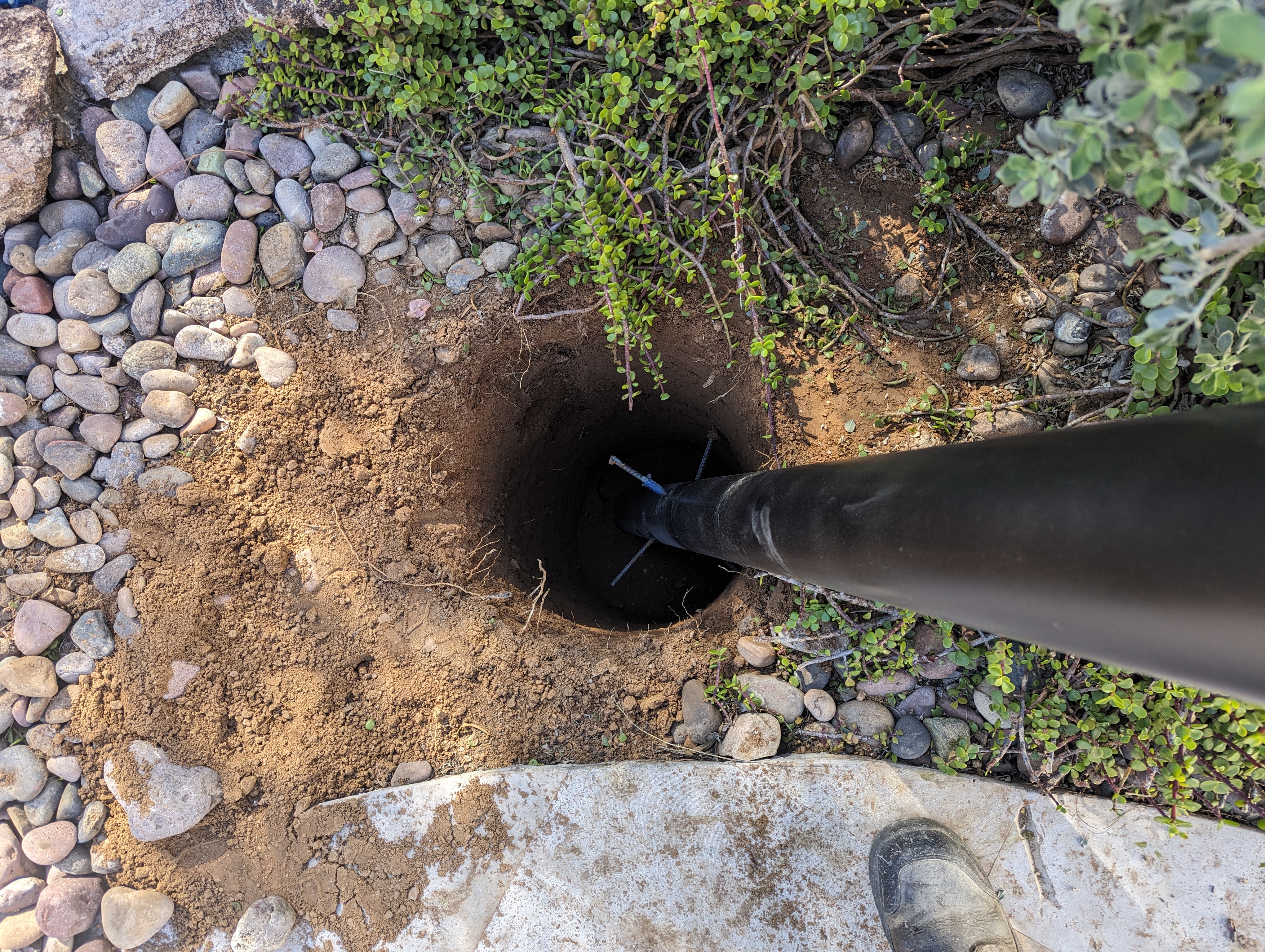
The Problem → The Real Problem
When you’re building a corner-tensioned shade sail you need to make sure those corners stay in tension. This seems obvious. What’s not obvious is that, when you’re building columns, the footers for those columns have to be very robust to withstand wind loads.
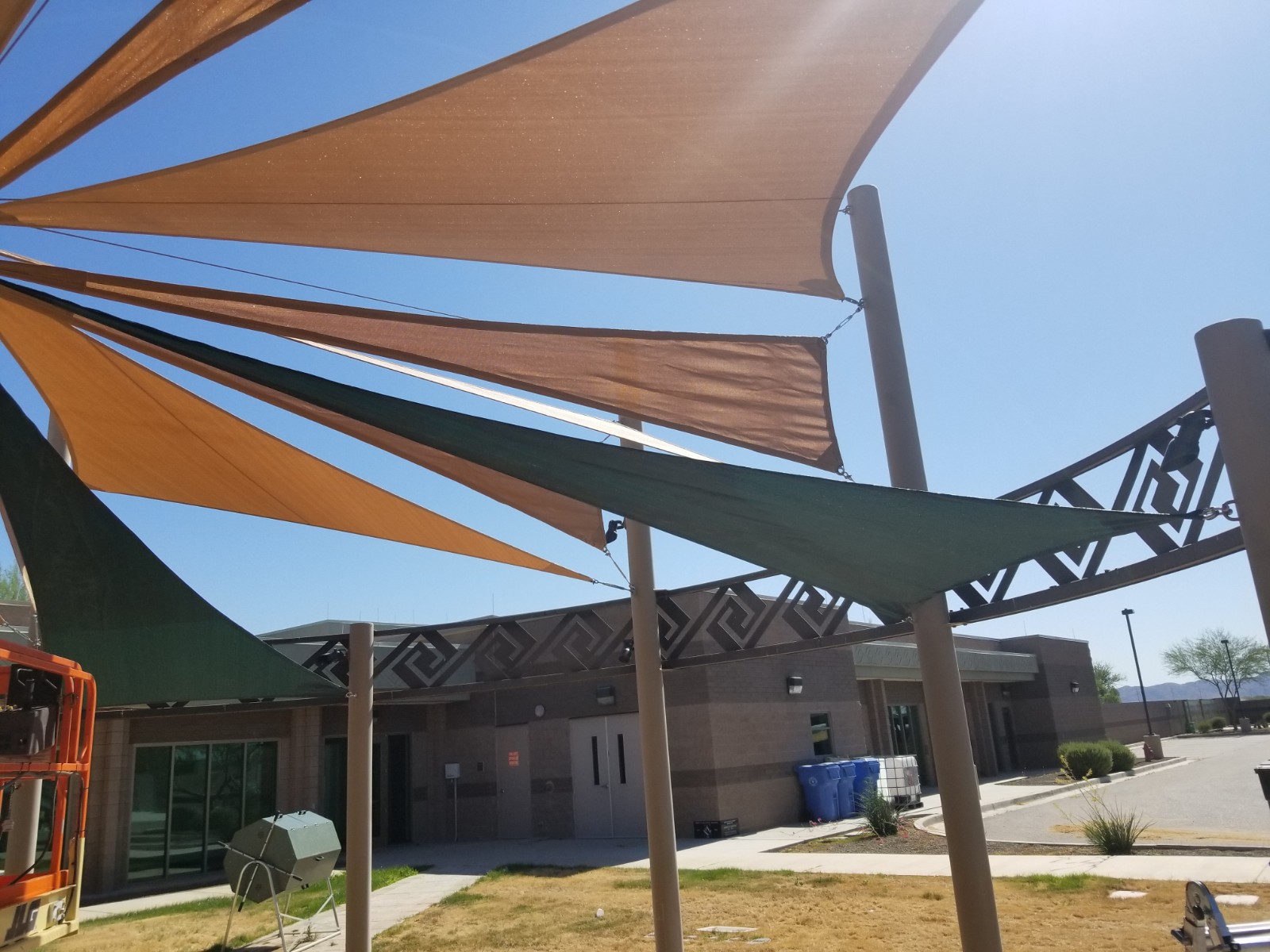
Before we get into the math, let’s look at what’s actually happening.
On wind loads for a second: Wind isn’t a universal force that applies only from one vector. Winds can affect your structure from the sides, top, and bottom; while a microburst may come from above, wind spill will often come from the sides. Additionally, winds from the sides can catch the underside of the sail and create uplift. Have you ever seen winds grab an umbrella and throw it into the next ZIP code? That’s the same concept.
Okay, so wind exists. Neat. How much do we have to allow for? Generally we have to build for a 3-second wind gust of 100mph and for a minimum wind load of 18.2 pounds per square foot. Let’s round that up to 20 pounds per square foot for the sake of calculation.
The Math Behind the Force → The Math Behind the Load
If you have, say, a four-corner 20’ x 20’ panel, that’s 400 square feet. Multiply that by 20 and we have to constrain a force of 8,000 pounds. 4 tons. 1 ton at each corner, applied at the distal end of a cantilever. That’s not nothing.
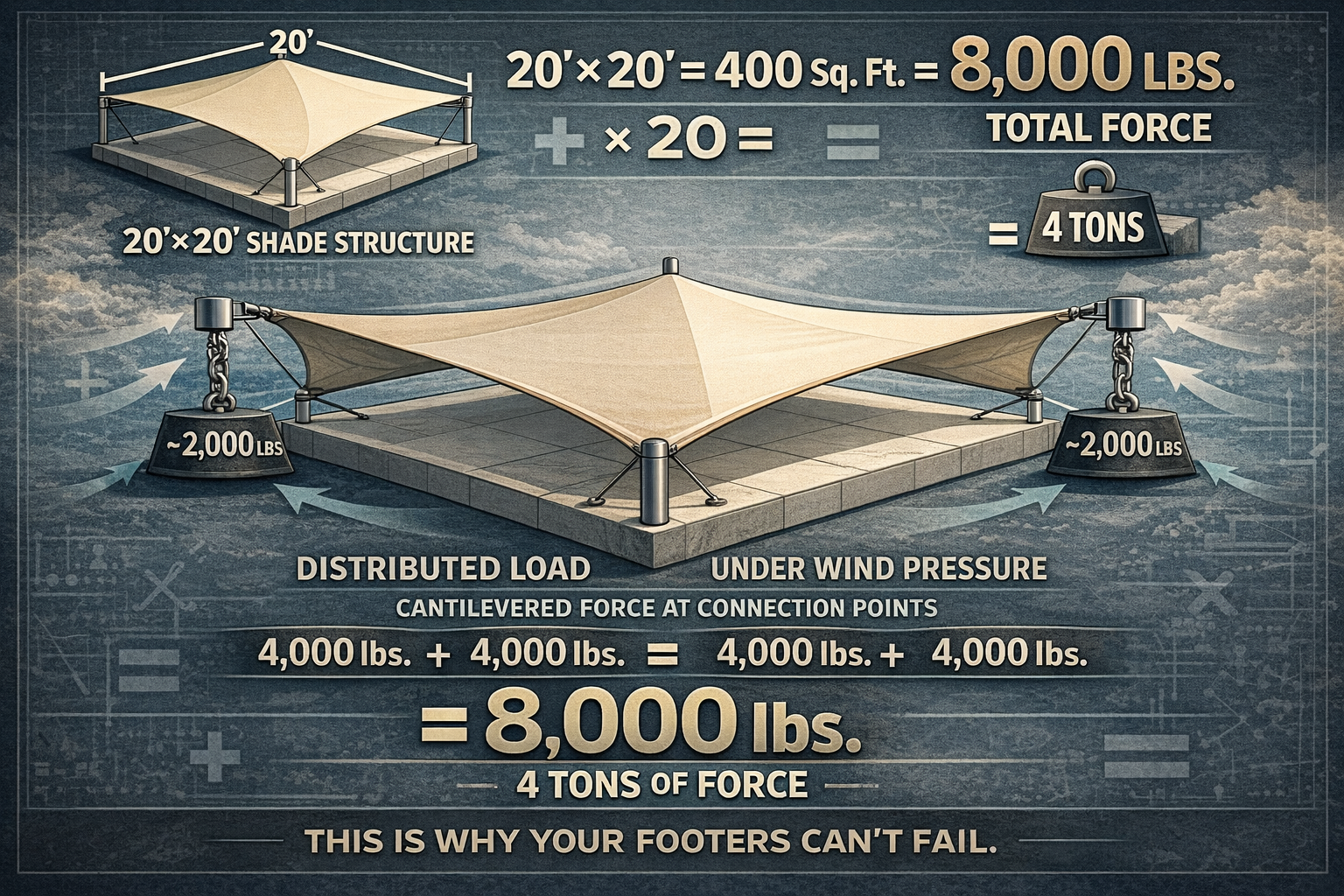
Why Footers Matter → Why Footers Actually Matter
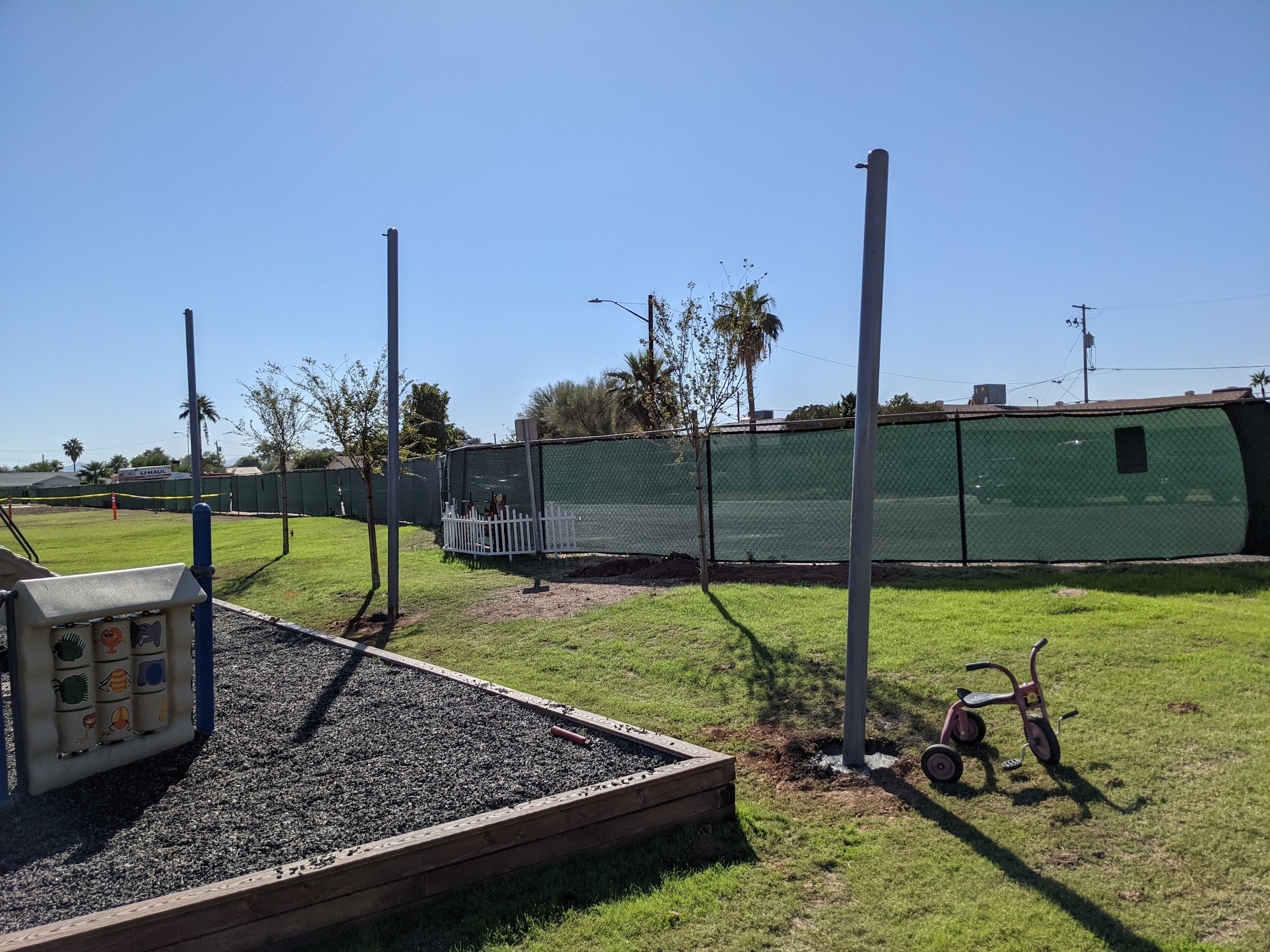
Obviously materials have a big impact on what we do but I’ll leave that for another conversation: Right now I want to go into holes.
Most commonly we construct concrete footers (similar to piles) by digging a hole. How deep? The rule of thumb is that the footer should be 1/3 the total column height; if you have a column 8’ aboveground, the footer is generally 4’. Most commonly footer diameters are approximately 4x the diameter of the column that the footer supports. Yes, that’s deep.
Concrete Isn’t Enough (By Itself) → Why Concrete Isn’t Enough (By Itself)
Concrete is itself a pretty amazing material; while I won’t go into the history of concrete and the Roman use of lime clasts and slump and aggregate mixture here, it’s worth pausing a moment to be impressed at what concrete can do. However, concrete by itself is not the end-all. It is poor in tension and requires reinforcement, usually in the form of rebar; these can be spikes or cages, but a proper concrete footer does require some form of added strength. Concrete is extremely strong in compression but when you try to pull it apart – such as with a strong wind pulling on a sail – it will fail if not properly reinforced. Then your column comes out and your sail falls over and everyone is sad.
Concrete Isn’t Enough (By Itself) → Why Concrete Isn’t Enough (By Itself)
When a vertical footer itself is impossible or impractical we may turn to a spread footer. This is a footer that is built to be wide rather than very deep; it has the benefit of spreading load over a wider surface area, but the disadvantage of being less resistant to side-loading. Similarly to a vertical footer, a spread footer must always be reinforced. (All footers must be reinforced. Don’t just get a few bags of concrete and throw them in a hole; that would be a Bad Idea.) A spread footer seems attractive because you don’t have to dig as deep, but because it concentrates less weight down low the tipping point of the column raises and therefore the tip threshold lowers. When we do build a spread footer we almost always anchor it to bedrock with drilled and epoxied-in-place anchors.
Concrete Isn’t Enough (By Itself) → Why Concrete Isn’t Enough (By Itself)
The concrete pad of your porch looks like a spread footer so it must be just as good, right?
Not so much. Don’t just fire some Tapcons into your porch or driveway. That will not end well. The concrete used in typical residential and commercial pads is generally only 4” thick, which is nowhere near deep enough to embed the anchors required to properly secure a column anchor for a shade structure. Think about it this way if you’re trying to visualize how much force this is: Take your column and bolt it to your driveway. Now drive a truck right into the column. Think the concrete will hold? Nope, probably not. The same applies with a sail that catches a massive wind gust: It will crack the concrete and end in sadness.
Final Takeaways → What This Means for Your Build
Ultimately, what are the lessons on building a footer?
Broadly speaking, deeper is better than wider. Always use a rebar cage or reinforcement protocol. Even though you don’t see them, don’t skimp on the footers: They’re the first line of defense between a beautiful, useful structure and a bunch of guys scratching their heads while standing around a tangled and expensive mess.


